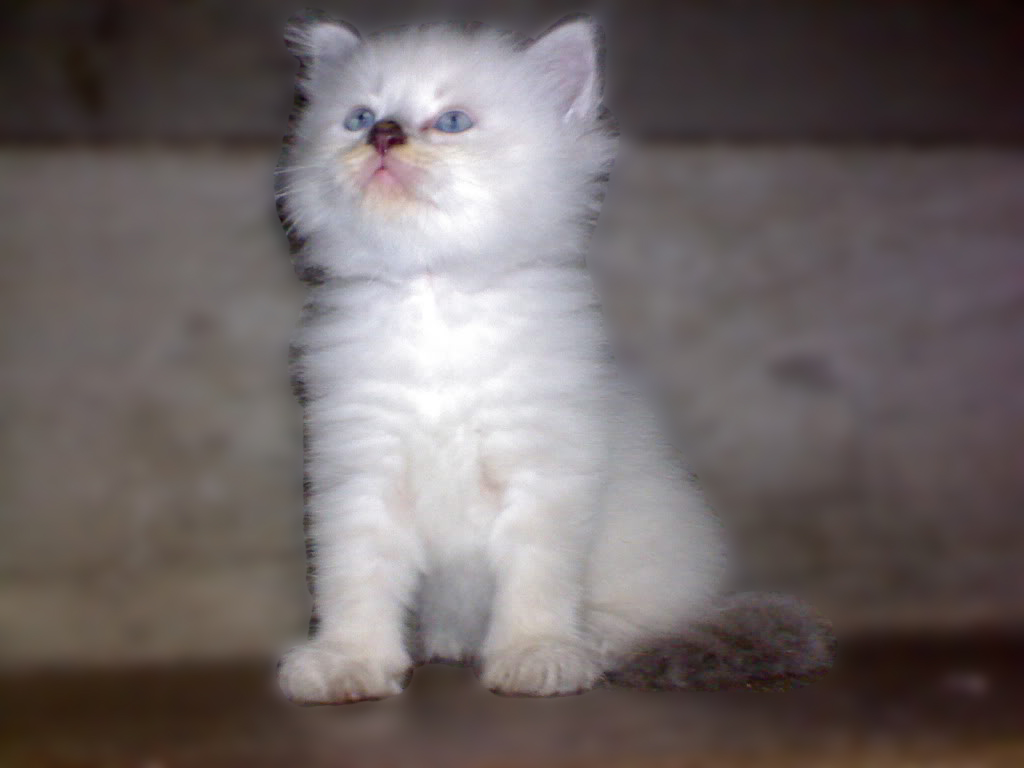
I started taking care of Puspins (short for Pusang Pinoy) since
mid 80’s. I’ve been feeding them table food because cat food was not yet
popular here by that time. Most of my puspins lived for 12 years or more. Never
did I encounter major health problem with them. Most of them died because of
old age and some just left. In the early 90’s, a friend of mine gave me a
Siamese cat. I was amazed by this cat’s ability to hunt. Since they have breed,
I was under the impression that they belong to the upper standard of the
domestic cat kingdom and doesn’t know how to hunt but I was wrong. They are as
good as our puspins in hunting. They also reproduce like mushroom. Whenever I
have kittens, I just gave them out to qualified owners but unfortunately,
others are great pretenders. If it’s free and has value, they’ll do everything
to have it to the point that Siamese runs freely in our barangay.
My dream cat is a persian cat an I had my first Persian last 2004. Her name is
Snowie. She’s a pure white traditional Persian. During that time, I don’t even
know what the breed standard is for this cat. All I know is that they have long
coat and I’m really attracted to it. I’m
familiar with the peke-faced persian but I really had a hard time finding one
and when I found one in Sulit.com, I have to sell my car just to buy one but I
did not do it…yet.

I fed Snowie with dry cat food. She lived only for 3 years
because she suffered from FIV. Vets (as usual) do not know the root cause of
this disease. I spent around P7,000 just to save her but our effort was futile.
Snowie left us together with 3 kitties insider her tummy. I remember during the
time when I was looking for a persian through Sulit.com, Adpost.com,
Philippinepetfinder.com and OLX, I was often told that what they have are flat
face persian kittens only to find out that they are traditional doll face. I
was even informed that they have this semi-flat faced Persian. Semi-flat? All I
know is Traditional and Flat faced. Can’t find that semi-flat persian term in
the internet. It’s only in the local site that I encounter this term. So is
this only in the Philippines? Although I’ve seen several pics posted in the
local site, I want to see one live. Until the time I saw this ad in Adpost.com
selling a Himalayan with a semi-flat face. I didn’t think twice. Drove to the
breeder’s place and saw these Himalayan kittens in the cage. I fell in love
with one of the kittens. She’s a blue point himmie with short snout and nose
slightly located below the eyes. So, it makes sense that this be called semi
flat. They do also have tear duct problem just like any other peke faced Persians.
I asked for the parents. The dam is a traditional faced himmie and the sire is flat face. The face is flat but the nose is still located
below the eyes. It almost doesn’t have snout.

Above is not the actual
picture (
courtesy of http://www.vetstreet.com/cats/persian)
but face is similar to him, even flatter. I got
the himalayan kitten and named her “Greta”.
She’s a blue lynx point himalayan.
She shed a lot after
giving birth
Now I already have a semi-flat persian (Himalayan
is a pointed persian). She’s a bit harder to maintain because of her eyes. Tears
overflow because of the blocked tear duct but just the same, she’s lovely. During
that time it’s only here in the Philippines that you will encounter “semi-flat”
persian (at least the term).
I started breeding Greta. I
learned on my research that the best age to breed your queen is at the age of
two so I waited until that time. When she turned two, I bought Pepper. he was
10 months old then. He’s handsome. His has a long flowing coat, great
confidence when walking and a muscular built body.
They have produced several
quality kittens. Most of them are lynx point.
How do I take care of my Persian cats? Is there any difference
here with other countries? Climate is an advantage for most of the countries.
During hot weather condition, our Persians are having several challenges like
breathing problem and worst, heat stroke. This is true especially on Peke faced
Persians. Most of the Filipino cat lovers know what to do during hot weather.
The very basic step is to keep them cool. Wiping them with wet towel several
times during the day will really help plus providing them with cold water to
drink. Proper ventilation is also a plus. Because of their coat, most of the Persians
here are harder to maintain. Their coat needs daily brushing. A single missed might
mean a disaster because of matting.
Do our cats conform with the breed standard? Most of them
not. Snowie, Pepper and Greta are way out of the standard as stated in the CFA
(Cat Fanciers Association) standard, the largest feline organization in the
world. Below is the Sire of one of my CFA registered kittens. He’s somehow within
the standard.
Picture courtesy of Norden Cattery
But does it really matter? Some may say yes. Some might not
even care. To be perfectly honest, for me what matters most is the health of
your cat. Conforming to the breed standard doesn’t mean that you have healthy
cats. He may be a champion but it takes a while to know if he’s perfectly
healthy. Ok, let’s look at it this way. Traditional persian is not recognized
as the breed standard but is definitely much healthier than CFA recognized
persian. It doesn’t have breathing problems, no tear duct blockage, can jump
higher (this is very true) and many more. So why peke-faced is the breed
standard? It’s mainly because of its physical feature. That’s the main reason. Health
wise, it has no match with the traditional persian. Sad but true. Some are base
on the physical appearance and not the physical capabilities of the cat.
So how do I know if what I’m going to buy is a pure breed
traditional persian? It’s hard. FFPI papers, local cat organization here
affiliated with CFA won’t even give you assurance that you have a pure breed
traditional persian. You have to rely on the physical aspect of the kitten and
its parents. Here’s what I’m going to look into if ever I’m going to buy
another traditional persian:
-
Heavily boned legs
-
Broad and short body
-
Long flowing coats
Remember that we’re talking about breed quality and not
health. It’s totally a different story. How am I going to determine if the
kitten I want to buy is healthy? If the kitten is feeding raw, no questions
asked. I’ll definitely get him. Other than this, I’ll think twice or seek help
of the professional. I will discuss here tomorrow what are the common diseases
of persian and ways of preventing this and what am I going to look for if I want
a healthy kitten.